Is Your Life-As-It-Is The Ultimate Truth? On the Sameness or Difference of the Conditioned and Ultimate
Is the whiteness of a conch, the same or different from the form of the conch?
This is the fourth post in our Summer Series addressing The Sutra That Explains the Profound Meaning (aka, Samdhinirmocana Sutra; below referred to as “the sutra”). Our posts here on Ghost will first provide background on the basis (i.e., the ultimate) in order to clarify the path work for which clear understanding of the nature of mind is essential.
You may have heard that “form is emptiness and emptiness is form.” Or that “nirvana is samsara.” The sutra digs deeply into this very teaching in a koan-like way, and offers a nuanced and direct pointer. That pointer puts us in a corner where we cannot move an inch. And like a koan, the sutra seems intent on provoking an immediate, direct perception of the ultimate.
What is it?
Record of Going Easy, Case 50: Xuefeng’s "What Is It?":
One of the monks also said, 'What is it?'
Xuefeng then hung his head and went back inside the hermitage.
What is it, indeed.
By challenging the teaching that nirvana and samsara are the same (and the corollary that nirvana and samsara are different), the sutra offers an explanation for what many long-time Zen practitioners have observed in the field over the past two or three decades—a shift away from focusing on awakening and a concomitant decline in the intensity of practice in most Zen groups, especially in the Soto realm.
The Rinzai Zen Facebook group recently discussed this very phenomena, prompted by the astute observations of a long-time Soto practitioner. To this point, we have heard Soto teachers telling students that their life, just as-it-is, is it. Below you will find a powerful refutation of this very notion (and the corollary that your life-as-it-is, isn’t it).
In this post, we'll offer you some essential background necessary to understand the Buddha's teaching in the sutra's Chapter 3: The Question of Wholesome Pure Wisdom, especially regarding the Five Paths. We'll then turn to several arguments the Buddha raises that refute the notion that the conditioned and ultimate are the same or different. We'll close with ten analogies that the Buddha uses to make this point clear.
By the way, Dogen and Rujing discussed this issue. They both declared that the conditioned is not the same as the ultimate, and leave it at that. You can find our translation and annotations in this recent post:
 Dosho Port
Another teacher conference and the question
We begin again with the setting of the teaching and the question.
As this chapter opens, we meet a Bodhisattva named Wholesome Pure Wisdom (Suvisuddhamati). Right out of the gate, Wholesome Pure Wisdom notes that the Buddha taught,
Wholesome Pure Wisdom then shares with the Buddha about having attended a conference similar to that attended by Dharma Gushing Forth in the previous chapter, except instead of a large gathering of non-Buddhist teachers, this was a gathering of Bodhisattvas in the stages of resolute practice. These Bodhisattvas had gathered to determine whether conditioned phenomena (aka, your life-as-it-is) is the same as or different from the ultimate.
And although no verbal brawls ensued like those at the non-Buddhist teacher conference, these Bodhisattvas offered opinions on every side of the matter (based on analytic thinking), but couldn’t agree about the sameness or difference of the conditioned and the ultimate. Wholesome Pure Wisdom asks the Buddha,
Indeed, the Buddha tells us that all the Bodhisattvas at the conference—those who thought that the conditioned and ultimate are the same, those who thought they are different, those who thought they are both the same and different, and those who thought they are neither the same nor different—were not telling it like it is, and were not properly oriented.
If there's another option, what is it?
Likewise, Wholesome Pure Wisdom also tells the Buddha,
Strong words for Bodhisattvas doing their utmost in the stages of resolute practice. Why were these Bodhisattvas so limited?
It has to do with how they were at the stages of resolute practice. These stages refer to the first two of the Five Paths (a frequently referenced Mahayana developmental process). Before we get to the Buddha’s answer, let’s first dig into the Five Paths in order to more fully understand the specific limitations of Bodhisattvas at these stages of training.
The Five Paths
The first of the Five Paths is the path of accumulation. At this initial stage of the Bodhisattva path, the practitioner gathers energy and skills for perfect awakening by timelessly cultivating the five faculties conducive to liberation—faith; perseverance; mindfulness; samadhi; and wisdom. It is at this stage that the practitioner develops the aspiration to realize awakening for the benefit of all beings, and the deep faith that this awakening is a real possibility.
The second of Five Paths, the path of application, is grouped with the first path in what the sutra calls the stages of resolute practice. At this stage, the Bodhisattva timelessly engages in the three trainings (i.e., precepts, samadhi, and wisdom) in order to begin uprooting the afflictive and cognitive hindrances.
The afflictive hindrances include the six primary afflictions (desire; anger; ignorance; pride; doubt; and false views) and their twenty secondary afflictions. The cognitive afflictions are those arising from the fundamental error that phenomena intrinsically exist. At this stage of training, the manifest activity of these hindrances are quelled, but the seeds stored in the alaya vijnana (aka, the storehouse consciousness) are still in the game. Given fitting causes and conditions, they will bloom into conscious awareness.
The third of Five Paths is the path of seeing. Here the bodhisattva directly and intuitively realizes the non-duality of phenomena—that both grasper and grasped arise dependently and are essentially empty. This path aligns with what we call kensho in the Zen Way.
The fourth of Five Paths is the path of practice. At this stage, the Bodhisattva repeatedly turns the light around in mere-perception so that what has been initially realized in the path of seeing is more and more fully integrated. Mere-perception is purified through non-discriminating wisdom. This path aligns with post-kensho training in Zen.
The fifth of Five Paths is the path of no more learning. The Bodhisattva now transforms the basis (aka, the eighth consciousness, alaya vijnana), dissolving the afflictive and cognitive hindrances. The seventh consciousness, manas, is transformed into pure cognition.
To this point, and as a reminder of the possibility of this one great life, this calligraphy, by one of the great masters in our koan lineage, hangs in one of our practice meeting rooms:
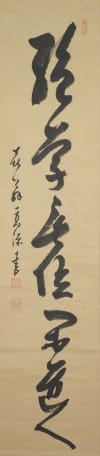
The Bodhisattvas attending the “Conference to Determine Sameness or Difference between the Conditioned and the Ultimate” had been vigorously doing the work of cultivating the five faculties and the three trainings, but were delaying getting to “... the subtle character that completely transcends difference or sameness of conditioned things.” They had not come to the path of seeing, let alone the path of no more learning.
Had old Xuefeng asked them, "What is it?", no matter what argument or Zen antic they put forth, he would have known that they had not yet realized it. So, he would have hung his head and gone back into his hermitage.
What is it?
In the sutra, the Buddha responds by first affirming Wholesome Pure Wisdom for seeing and telling like it is. Apparently, the Buddha did not see Wholesome Pure Wisdom's comments about these Bodhisattvas being “... childish, obscured, unclear, unskilled, and not properly oriented” as speaking ill of others. After all, refraining from speaking the truth can be elevating the self (aka, virtue signaling), so the Buddha doesn't go there.
The Buddha then goes on to the question about the nature of the conditioned and the ultimate—are they the same or different? His refutation includes these three arguments, each with two parts.
- What is it?
- If the conditioned and the ultimate were the same, then ordinary people who know the conditioned would also know the ultimate. So, ordinary people would know the bliss of nirvana—and they don’t. It seems then, that it would be a hard sell to convince students that their life-as-it-is is the ultimate. But many today seem interested in using the buddhadharma to affirm their present stage of development rather than making difficult choices to do the timeless work. This desire aligns quite well with the interest on the part of some teachers in "audience capture." Nevertheless, the Buddha says that those who say that "[...] the character of the conditioned and the character of the ultimate are the same are improperly oriented."
- On the other hand, if the conditioned and the ultimate were different, then those who realize the ultimate would not be free from the conditioned (like those afflictive and cognitive hindrances noted above)—and they are. Woncheuk summarizes: "If the ultimate truth were completely different from the characteristics of phenomena, then one who has seen the truth should not be able to eliminate those characteristics, because the truth and phenomena would be different. But in fact, one can eliminate them, so they are not different."
- What is it?
- If the defining characteristic (i.e., the nature) of the conditioned were the same as the defining characteristic of the ultimate, then this characteristic would be included in the conditioned and vise versa. However, the defining characteristic of the conditioned is defilement (i.e., conditioned things appear to have intrinsic nature) and the defining characteristic of the ultimate is suchness, (i.e., lack of intrinsic nature). So, clearly, the conditioned and the ultimate could not have the same nature.
- If, on the other hand, the defining character of the conditioned and the ultimate were different, then suchness could not be the nature of all phenomena—and it is (see below).
- What is it?
- The Buddha points out that if the conditioned (aka, your life-as-it-is) and the ultimate were the same, then there would be no need to practice in order to realize the ultimate. And, given that the Buddha himself practiced as if his hair were ablaze, and all the ancestors following the Buddha have followed suit, then we definitively know that the conditioned and the ultimate are not the same. If you doubt this, see the first of the Five Paths above, the path of accumulation, for what to do.
Dogen, sharing the above view, said, "Even if the ancient sages were like this, how can we today dispense with wholehearted practice?" And yet, many practitioners today, spurred on by many so-called dharma teachers, take it easy, find other things to do, and don't prioritize practice as would be necessary if they were to realize their the true nature of this very life. - So is the conditioned and the ultimate different? No. As Woncheuk points out:
- The Buddha points out that if the conditioned (aka, your life-as-it-is) and the ultimate were the same, then there would be no need to practice in order to realize the ultimate. And, given that the Buddha himself practiced as if his hair were ablaze, and all the ancestors following the Buddha have followed suit, then we definitively know that the conditioned and the ultimate are not the same. If you doubt this, see the first of the Five Paths above, the path of accumulation, for what to do.
The ten analogies
Fortunately, the Buddha concludes this chapter with ten analogies that clearly make the point. The relationship of the ultimate with the conditioned is likened to the following:
- The whiteness of a conch;
- Yellowness of gold;
- The melodiousness of the sound of a lute;
- The fragrant smell of the aloeswood tree;
- The heat of pepper;
- The astringency of medicinal arjuna plant;
- The softness of cotton;
- Clarified butter and butter;
- The impermanence in all conditioned things, the suffering in all contaminated things, the selflessness in all phenomena;
- And the agitating character of desire and affliction.
These ten analogies are based on the six sense gates. The first two use the seeing sense gate. White and yellow represent the ultimate, and the conch and the gold represent the conditioned form. It can't be said that they are the same nor are they different.
The third uses sound. The melodious sound represents the ultimate, and the lute represents the conditioned. It can't be said that they are the same nor are they different.
The fourth uses smell. The fragrant smell represents the ultimate, and the aloeswood tree represents the conditioned. It can't be said that they are the same nor are they different.
The fifth and sixth use taste. Heat and astringency represent the ultimate, and the pepper and the arjuna represent the conditioned. It can't be said that they are the same nor are they different.
The seventh and eighth use touch. Softness and clarified butter represent the ultimate, while cotton and butter represent the conditioned. It can't be said that they are the same nor are they different.
The ninth and tenth use mental objects (i.e., dharmas). Impermanence, suffering, and selflessness as well as the agitating character of desire represent the ultimate, while conditioned things, contaminated things, and phenomena as well as affliction represent the conditioned. It can't be said that they are the same nor are they different.
The definitive conclusion
Are the conditioned and the ultimate the same or different?
"What is it?"
"What is it?"
Xuefeng then hung his head and went back inside the hermitage.
At Shake Out Your Sleeves and Go
 Shake Out Your Sleeves And Go