Bring Me Your Mind And I Will Calm It For You
"When you think that you've lost everything, you find out you can always lose a little more."

We recently wrote about the importance of prioritizing practice. This piece goes beyond that one in asserting that in awakening, we lose every thing—every bit of separation—and gain no thing. To more fully unpack this, we turn to an old and well-known Zen koan featuring Bodhidharma and Huike.
But first this from Bob Dylan's "Tryin’ to Get to Heaven":
You find out you can always lose a little more
I'm just going down the road feeling bad
Trying to get to heaven before they close the door"
Background
Bodhidharma and Huike, the first and second Zen ancestors in China, are semi-mythical figures. Twentieth-century Buddhist scholars first accepted that Bodhidharma existed, then they were certain that Bodhidharma didn’t exist, then later changed their minds again and are now pretty sure that he did exist.
Zen practitioners, just don't know.
In terms of koan work, it doesn't matter. The same methods are employed to enter a koan, and for the koan to enter us, whether the story is accepted as a story or constructed as the truth.
Nevertheless, a few biographical details
Bodhidharma was born in southern India, the third son of a king. He happened to meet the twenty-seventh Zen ancestor, Prajnatara, when he was a teenager. For more about Prajnatara, especially about the possibility that Prajnatara was a woman, see this:
 Shake Out Your Sleeves And Go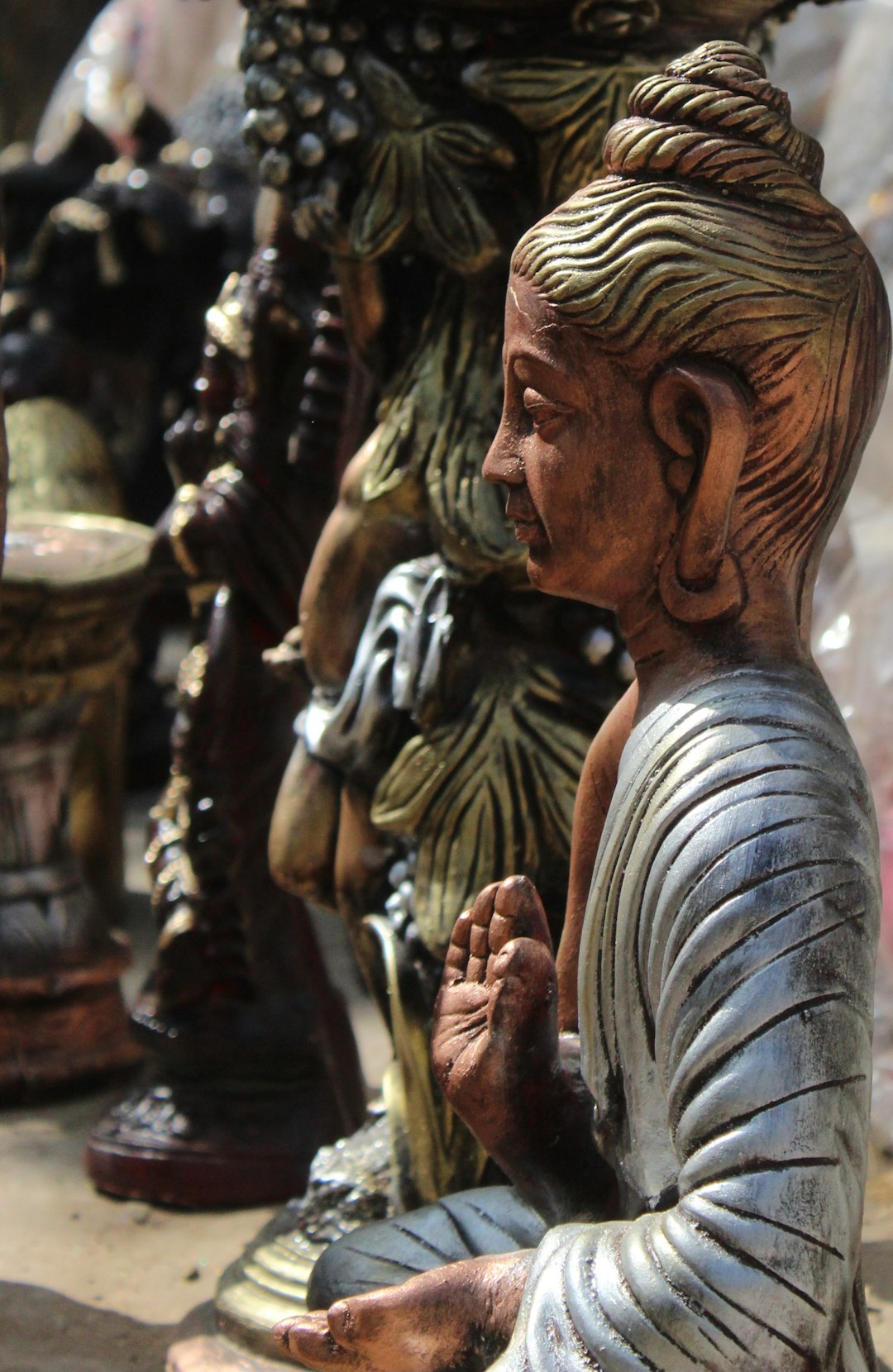
After Bodhidharma awakened, Prajnatara told him that 67 years after her death, he should go to China. Then she lived a long time, so Bodhidharma was very old when he finally started his journey to China. Once there, possibly in 527 CE, he had a meeting with Emperor Wu that didn’t go well. Scholars today are in agreement that this meeting probably didn't happen. Nevertheless, for more, see this:
 Shake Out Your Sleeves And Go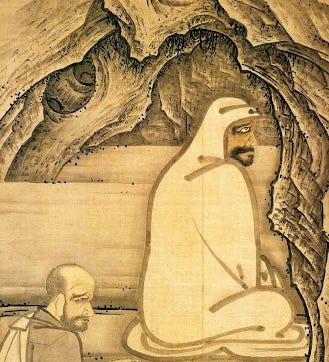
So that’s when Bodhidharma remembered Prajnatara’s prophecy that things wouldn’t go well in the south (to paraphrase, "People in the south are just trying to get something"), so he headed north to a cave near Shaolin Monastery. Once he arrived at Shaolin, he sat facing a wall there for nine years.
Everybody who happened to peek into the cave assumed he was doing absorption practice (Sanskrit, dhyana; Chinese, Chan; Japanese, Zen), and called him a Chan/Zen master. Because no true Chan/Zen master would linger in one-chopstick dhyana for nine years, many in the Chan/Zen lineage have denied that we are the Chan/Zen lineage. For more on what Bodhidharma was doing in a cave facing a wall, see this:
 Dosho Port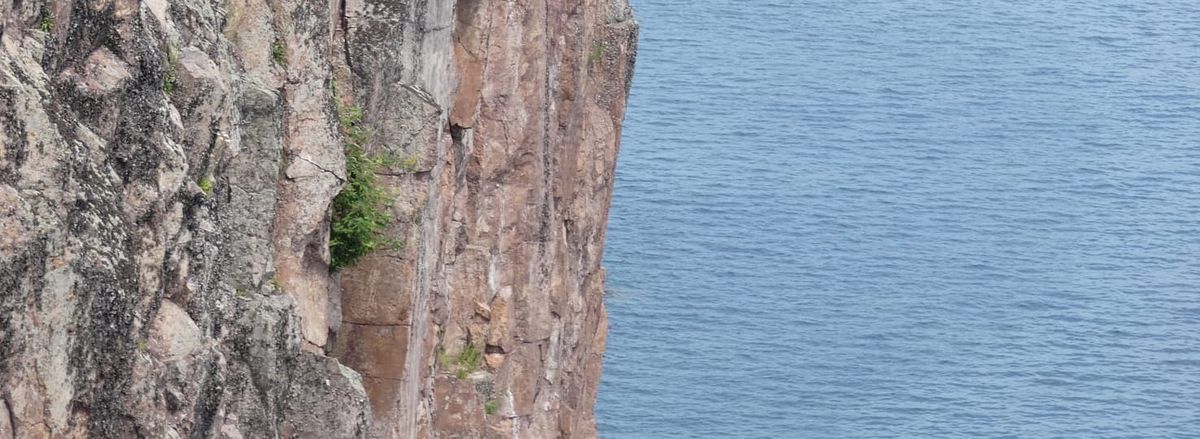
While Bodhidharma was sitting facing a wall, Huike (487-593) stopped by for dokusan. Since birth, Huike had been uninterested in worldly affairs and eventually received homeleaver precepts from a dhyana monk (not a member of the as yet unformed Chan/Zen school who deny being Chan/Zen, but a monk who specialized in absorption practice).
One day, Huike read a sutra about wisdom and "felt a transcendent sense of satisfaction," prompting him to sit in a profound state of calm stillness for the next eight years. Finally, a deva then appeared to him, perhaps in a dream, and told him that he was about to realize the Way, but that he needed a teacher. So Huike walked for about 500 miles (about a month of steady walking in straw sandals) to Bodhidharma’s cave.
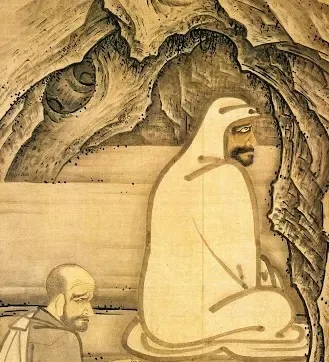
And that’s where the koan begins. This version is from the No Gate Barrier (Japanese, Mumonkan):
CASE 41: Bodhidharma Calms Mind
Bodhidharma said, "Bring me your mind and I will calm it."
The second ancestor said, "I have sought my mind, but I cannot grasp it."
Bodhidharma said, "Indeed, your mind has been calmed."
Other versions of the story develop the part about the second ancestor, Huike, standing in the snow. We'll follow Keizan’s Record of the Transmission of the Lamp (Denkoroku):
Finally, in the morning, Bodhidharma noticed that Huike was still at the mouth of the cave and so called to him, saying, "You’ve been out there in the snow for a little while. You must want something."
Huike said, "I only request that you, Venerable, out of compassion, open the ambrosia gate and liberate all living beings."
What a wonderful wholehearted appeal! Note that although Huike, like Bob Dylan, was going down the road feeling bad, he wasn't trying to get to heaven and escape the shit-show of samsaric existence. He beseeched Bodhidharma to liberate all beings.
"Ambrosia" refers to a nectar-like substance that flows into the mouths of sages. The "gate" or "method," refers to how when this nectar is shared with others, they are freed from the rounds of cyclic existence (i.e., rebirth). This ambrosia method is also shared with hungry ghosts. Hungry ghosts, you see, are desperate for satisfaction and, yes, they can't get none. Any nourishment they try to shove into their hungry big mouths bursts into flames before they can consume it. However, they are nourished by the ambrosia of dharma methods. Thus, in the Zen meal verses we offer them a bit of food and chant, “Oh spirits, we now give you an offering. This food is for all of you in the ten directions.”
Bodhidharma, however, was a truly cold guy and remained unmoved by this sincere appeal. He said,
It is no small thing that a great ancestor in the Sudden School, Bodhidharma, emphasized "[...] The unsurpassed marvelous Way of the Buddhas is to vigorously strive for vast kalpas." In other words, awakening may be sudden, but it can take a long while to get there.
In addition, it is worth calling out the point that Bodhidharma’s admonition starkly contrasts with most of what you find in Zen teachings these days where messages like "Your life as it is, is it" predominate. We've heard such teachers tell their students that enjoying a sunset is the same as doing zazen. Urgh!
Instead, Bodhidharma said to “[...] vigorously strive for vast kalpas, practicing that which is difficult to practice and enduring that which is difficult to endure.” And he wasn’t impressed with Huike's virtue signaling (i.e., standing in the snow all night crying). His response, to paraphrase, “That did nothing for your virtue, wisdom, or aspiration—all of which I find lacking. Jeez!”
Ouch! And that’s when Huike cut off his left arm.

We want to emphasize that we adamantly and unequivocally will not accept students hacking off a body part, including a left arm, for a koan demonstration. However, in order to undergo the liberative process, a student will need to cut off something near and dear—like their identification and attachment to themselves (aka, manas consciousness). "My precious."
Bodhidharma must have heard something like a scream (or a siren), and so he turned around again, and saw what Huike had done. He said,
So, Bodhidharma allowed Huike to join him in the cave, presumably after Huike had received emergency medical attention. Huike then spent eight years serving Bodhidharma. Sometime during that period, Huike came to Bodhidharma and said, "Your disciple’s mind is not yet calm. I beg the teacher to calm my mind."
Remember that before he came to practice with Bodhidharma, Huike had already spent eight years in calm stillness. And yet his mind was again not calm. Unlike cutting off his arm, this is normal. The calm mind is dependent on conditions, so although developing thorough competence in calming is part of what Buddhas do while they’re vigorously striving (doing that which is difficult to practice), by itself, the calm mind is insufficient.
Bodhidharma said, "Bring me your mind and I will calm it."
"Bring me your mind"—what a thing to say! These are the words of a great master.
In order to understand what Bodhidharma meant by “mind,” it is important to know that Bodhidharma was steeped in the teaching of the Yogacara (aka, Mind Only School). This school teaches the eight consciousnesses, with the storehouse consciousness being that consciousness that the sixth sense consciousness (including the conscious mind) and the manas (aka, ego consciousness) are contingent upon and abide in. The storehouse consciousness is like a vast river, the other seven are like waves. So, given these eight minds, which one was Bodhidharma telling Huike to bring him?
Later, Bodhidharma would tell Huike, "The Lankavatara Sutra is the essence of my mind." The Lankavatara is one of the important Yogacara sutras. Now, Bodhidharma is also reported to have said, "Do not rely on words or texts." So which is it?
For more on this see, Case 33: "What is the essence of mind?" and Case 34: "Why did Bodhidharma say, 'I’ve pacified your mind?'" in Going Through the Mystery's One Hundred Questions.
 Dosho Port (Author) Format: Paperback
Now, if Huike had just brought a copy of the Lankavatara to Bodhidharma, and said, "Here. You said this sutra is the essence of mind, so I'm bringing it to you," Bodhidharma might have smacked him with his own severed limb (see above).
Fortunately, Huike diligently worked through this issue, and finally came and said, "I have sought my mind, but I cannot grasp it."
Bodhidharma said, "Indeed, your mind has been calmed."
The koan does not say, as many koans do at this point, that Huike then awakened. This is because in seeking mind and not grasping mind he was practicing awakening, doing that which Buddhas find difficult to practice. As such, the koan demonstrates the movement from stopping (aka, calming) to liberative seeing (aka, kensho).
The task for the koan student is to bring this very mind.
Wumen’s comment
The great master Wumen (1183–1260) wryly observed, "The gap-toothed venerable barbarian traveled 10,000 miles, yet it could be said that he raised waves where there was no wind."
In Zen, such abuse—"gap-toothed barbarian"—is reserved for those most worthy of veneration. Bodhidharma had come all the way to China, not really 10,000 miles, probably closer to 1,200, but still a long way for an old guy.
In his comment, Wumen also raises the waves and wind metaphor, common in the Yogacara teachings. In the Lankavatara, for example, there is this verse:
Stirs up various kinds of waves—
Directly manifesting transformative functioning
Without interruption.
The ocean of the storehouse consciousness is also thus.
When hit by the wind of a perceptual object
It constantly gives rise to the waves of consciousness
Directly manifesting transformative functioning."
Yet, Wumen says that the waves Bodhidharma stirred up were not due to being impinged by the conditions, i.e., by a perceptual object. It’s as if there was nothing outside mind.
In the same vein, Wumen continues,
After all, Bodhidharma accepted Huike through the ambrosia gate (i.e., method). What method? "His six senses were inoperable"—echoing a portion of the Sutra That Explains the Profound Meaning where the Buddha lays out the method by which Bodhisattvas are considered wise (excerpt):
This is to do what is difficult to do, to become so intimate that there is nothing outside, and with constancy bring forth an unsupported mind. As we tell beginning koan students, "Just be MU completely with nothing left out."
We will return to this theme later in the month when we summarize the Sutra That Explains the Profound Meaning chapter on Mind. Meanwhile, during the upcoming Day of Retreat, we will work through the above sutra passage in detail.
Reminder
There is no Sunday session this week, August 9. On Sunday, August 16, a Day of Retreat will be held from 5:50am to 4:00pm CT, which includes a dharma talk by Sensei and Roshi. Paid subscribers are welcome to attend, and the registration deadline is 12pm CT on Monday, August 10. Contact us here for more information.