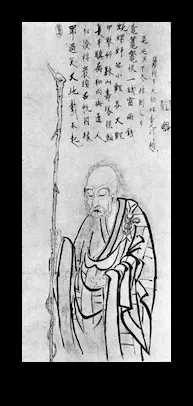
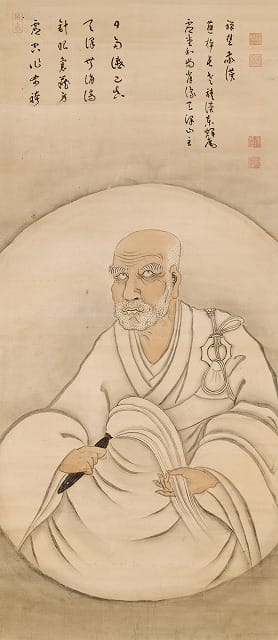
Your Parents’ Rotting Red Flesh: The Meeting of Pivotal Zen Ancestors Rujing and Xutang
Early in Hakuin Zenji’s (1686-1769) teaching career, one of the monks training with him at Shoinji, Myoseki, lost his mother. Myoseki was from the north of the main island, about 250 miles (or a good ten-day walk) from Shoinji. There is no indication that Myoseki visited his mother during her decline or that he traveled to his hometown for her funeral. However, a memorial service was held at Shoinji. During Hakuin’s incense offering, he shared an old koan involving Rujing and Xutang, as well as a few words about the case.
In this post, we’ll share the koan, the essential background to the interaction, and some related dharma issues, touching as they do on some of our recurrent themes. We’ll also share Hakuin’s brief comments.
First, the koan
Xutang replied, "Meritorious activity cannot be rushed."
The Rujing then struck Xutang with a single hand. Xutang spread out both arms and replied, "For now, little by little."
Rujing then stopped.
In this koan, the Zen master is the Caodong/Soto teacher Rujing (1162–1228) from whom Dogen received transmission—the last Chinese ancestor in the continuing Soto succession. At the time of his encounter with Xutang, Rujing was the abbot of one of the main imperial monasteries, Qingzi. Rujing moved from Qingzi to Tiantong in 1224, so this encounter with Xutang (1185–1269) would have occurred before 1224 (the year he met Dogen at Tiantong).
Xutang had become a monk at an early age and traveled widely to train, seeking great awakening. He eventually succeeded in his quest while training under Zen master Yun’an (1156–1226), a 26th-generation successor in China in the Linji lineage. Xutang became Yun’an’s successor and after more than 30 years of training, he became a teacher himself as well as the abbot of prestigious monasteries like Qingzi. Eventually, Xutang gave transmission to Daio, the first generation in the continuing Japanese Rinzai lineage.
Learn more about Xutang in The Record of Empty Hall: One Hundred Classic Koans.
After Xutang completed his training with Yun’an and received dharma transmission in the Linji lineage, he went on pilgrimage in order to continue the work of opening up his awakening. One of the first masters Xutang chose to encounter was Rujing.
About forty years later, one of Dogen’s monks, Giin (1217–1300), brought Dogen’s Eihei goroku (the abridged version of the Eihei koroku) all the way to China and asked the now revered old master Xutang to review it. Xutang wrote the following colophon (translation by Kogen Czarnik Osho):
See more about this here (including an explanation about "the change of Lu"):
 Dosho Port