Hiding Traces in Mist, Streams, and Rocks: On Renouncing Worldly Affairs
"I vow that this body, born of my mother and father, be dedicated to the boundless ocean of vows of the Three Treasures. In all matters of daily life, may I never depart from the Buddha’s teaching [...]." - Daichi Sokei Zenji

Neither fame's reins nor profit's chains could keep me.
I hide my traces among mist, streams, and rocks.
Wild greens simmer in a broken-legged pot—
Living in the mountains, I simply follow the way of the Ancients.
- Daichi Sokei Zenji, translation by Hojun
In this post, we sing praises to those who renounce the conventional world, and there are two parts. In the first part, we will explain why renouncing worldly concerns is difficult yet important. The second part is about the life of Daichi Sokei Zenji whose verses appear here, including above, and his vows, perfumed as they were by simplicity and the renunciation of fame and gain.
Granted, renunciation of any kind is not a popular theme in today’s spiritual marketplace. However, in the past, it was the heart of cultivating-verification for many practitioners—known and unknown (especially the unknown). They often hid their “[...] traces among mist, streams, and rocks.”
Instead, what we often find today, even among those who have taken "home-leaver" vows, is a full-on embracing of worldly affairs, resulting in ostentatious lifestyles, and/or conflating political agendas with the buddhadharma. Sad!
 Dosho Port
Decades ago, the British historian Arnold Toynbee said, "The coming of Buddhism to the West may well prove to be the most important event of the twentieth century." This fed the dream that Buddhism would transform the West (i.e., capitalism). And although every influence goes both ways, it seems to us that capitalism is mostly having its way with the Buddha Way.
Just look at the teachers parading their dharma resumes, taking the teaching seat adorned in precious fabric (e.g., one whose koromo and rakusu coordinate with the designer wallpaper backdrop), and offering pricey retreats about realizing the Way that contain almost no practice (and thus almost no real chance of realizing the Way). The above, and so much more, look like teachers and practitioners engaged in the full-on commoditizing of the Buddhadharma—and themselves. Someone recently referred to this as "the Buddhist-industrial complex."
Suggestion: if you are a dharma teacher and find yourself about to put out something similar to what follows, you might pause and have a little me moment, a "non-AvaTara moment," about your intention for offering the dharma:

And yet, if a practitioner really sees for themselves the perniciousness of self-clinging, then that should cause one to stop and discern (and abandon your AvaTara dream). This reflection might lead to practicing as if one's hair were ablaze just as naturally as putting your feet on the floor when you get out of bed in the morning. Not dharma hustling for the dollars of donors, or cryptocurrency, even.
One teaching that informs us about the pernicious nature of self-clinging is the eight consciousnesses as presented in the Yogacara, based on The Sutra That Explains the Profound Meaning—our present focus of study on the Vine. One key teaching is that the sense gates, sense objects, and sense consciousnesses are contingent upon and live in the unconscious storehouse consciousness—the home of all the karma ever created by us. So, everything that is perceived by the sixth consciousness (i.e., the conceptual, conscious, discriminating powerhouse), is constructed in the light of the twisted past.
 Dosho Port
And our conundrum gets even more tangled. The deluded sixth consciousness only perceives what passes through the seventh consciousness (aka, manas or ego-consciousness). Indeed, manas functions as the organ through which our mind-consciousness sees whatever arises in the storehouse. Poor old manas is afflicted with self-view, self-conceit, self-cherishing, and ignorance. So, the sixth consciousness perceives through an organ of self-affliction what was constructed in the storehouse by past "selves."
That’s the corner we're in—until we become fully awakened Buddhas—more and less, we make everything about the self. That includes our loves and hates, “selfless” actions, and vows. So, until attaining Buddhahood, studying this stinky self with a sense of humor, illuminating self-clinging again and again, is essential. And by “fully awakened Buddha” we don’t mean someone who has had a little kensho experience, passed through some koans, and/or received the highest dharma transmission in the world. Such things might be steps on the timeless Bodhisattva path—or insight co-opted by selfing.
The good news is that it is possible to transform this self-cherishing at the base—the storehouse consciousness—through diligently practicing the first four paramitas (giving; precepts; patience; and enthusiasm). This process, the gradual side of purification, makes our stinky self-clinging vividly clear and provides inspiration for ongoing training. As Daichi Zenji put it in the above verse, “Neither fame's reins nor profit's chains could keep me” and “Living in the mountains, I simply follow the way of the Ancients.”

Then, through the fifth and sixth paramitas, samadhi and wisdom, we can “plant our mattock firmly in the storehouse consciousness,” as Hakuin Zenji put it, and the base consciousness will suddenly transform into the Great Perfect Mirror Wisdom.
But if we don’t continue our practice of renouncing worldly affairs after first glimpsing the empty mirror, we’ll never transform the seventh consciousness, manas, and its selfing afflictions into the Mirror of Essential Identity. Through continued training, the sixth consciousness transforms into the Marvelous Observing Wisdom, and the first five consciousnesses transform into the Wisdom for Completing the Work.
For more on this, see this:
 Dosho Port
Before we move onto more from Daichi, this from his like-minded predecessor, Han Shan (another old recluse, this one from the Tang Dynasty)—joyful, realized, boundless, wild, and free:
The cloud road's choked with deep mist.
No one gets here that way,
but these Heaven-Terrace Mountains have always been my home:
a place to vanish among five-thousand-foot cliffs and pinnacles,
ten thousand creeks and gorges all boulder towers and terraces.
I follow streams in birch-bark cap, wooden sandals, tattered robes,
and clutching a goosefoot walking-stick, circle back around peaks.
Once you realize this floating life is the perfect mirage of change,
it's breathtaking—this wild joy at wandering boundless and free.
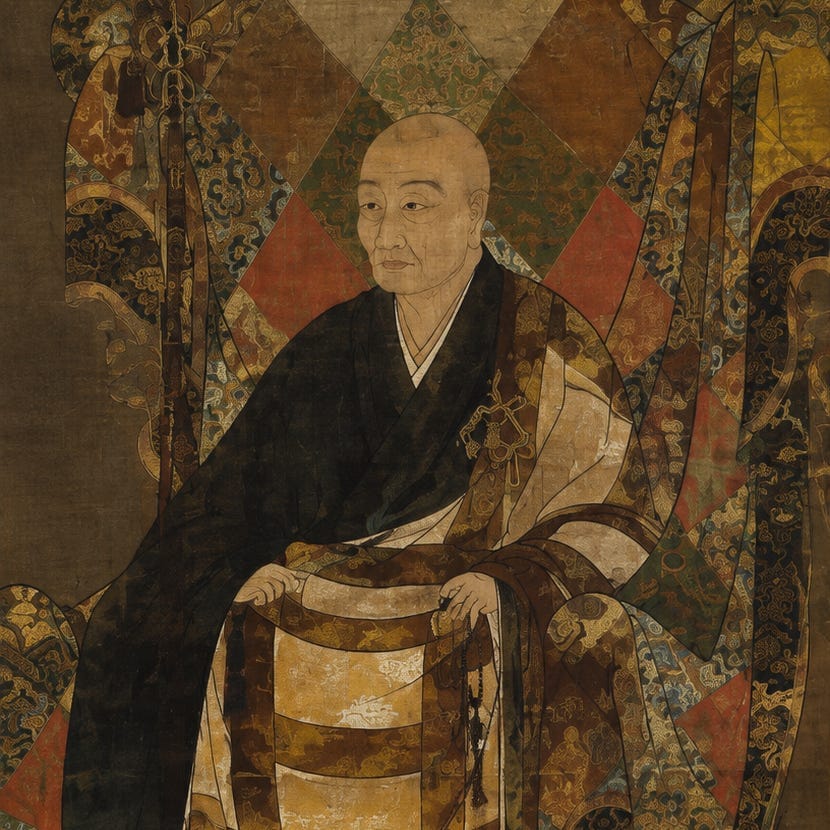
The life and vows of Daichi Sokei Zenji (1290–1366)
This is the second part of singing praises to those who renounce the secular world, and it also has two parts. The first part is about the life of renunciation as lived by Daichi Sokei Zenji.
Now, although we are using the example of someone who actualized renunciation by living the life of a home-leaver, it is unlikely that many of our readers are living in remote mountains in solitary retreat now, nor are most likely to do this exact style of practice in the future.
However, the spirit of renunciation (aka, Way Mind) is about living a life based on the practice of simplicity in food, clothing, and housing (or earnestly moving toward such a life). We would add to this list the practice of simplicity in activities—so many people today are engaged in so many things, going in all ten directions at once. Simplicity in activity is about slowing down and focusing on what's most important. This echos one of Kamalasila's "Five Inner Conditions for Attaining Samatha:"
"To thoroughly abandon having many activities."
The spirit of renunciation can be embodied in any lifestyle. You will find, if you haven't already, that the spirit of renunciation runs directly against the grain of the technologically-oriented, capitalistically-enhanced desire realm.
Actualizing the spirit of renunciation begins by taking concrete steps to simplify our life, freeing up energy for dharma practice. One student who recently started training on the Vine of Obstacles began by giving up social media. This had a powerful effect on her energy for the Way.
For more on the spirit of renunciation:
 Dosho Port
So, given that extended qualification, we now to turn our attention to the life of Daichi.
When Daichi was young, he took home-leaver vows with Kangan Giin (1217–1300), the founder of the Higo branch of Soto Zen based in Kyushu (a southern island of Japan). Giin is the monk that took Dogen's Eiheikoroku to China for verification. He also wrote capping phrases and verses for each of the fascicles in Dogen's Shobogenzo, Flowers Blooming on a Withered Tree (translated by Steven Heine).
After Giin died, Daichi traveled widely, then trained with Keizan Jōkin (1268–1325) for seven years. He realized great awakening when he saw a monk simply walking in the corridor. Daichi then spent ten years in China training with the Linji/Rinzai master Gulin Qingmao (1262-1329).
In his attempt to return to Japan, Daichi survived shipwreck aboard the Shinan ship, a vessel that was recently recovered from the ocean's depths. He then spent a year in Korea. After Daichi succeeded in returning to Japan, he received dharma transmission from Meiho Sotetsu (1277-1350).
Sometime later, Daichi settled on a remote mountain in Kyushu. Although this was far from Eiheiji, Daijoji, and most of the other main monasteries of Soto Zen, it was close to the Higo branch in which he had originally practiced. Daichi established a monastery/hermitage, Hogizan Shogoji, on this remote mountain and lived there for twenty years, maybe with a small number of monks, all together avoiding fame and gain.
See this for another example of living a life of solo retreat:
 Dosho Port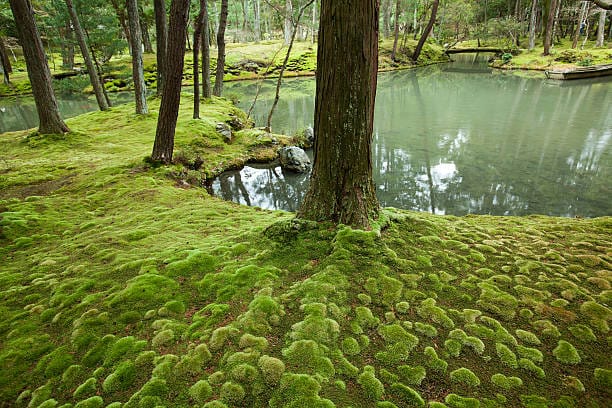
Daichi’s poetry is still read today in Japan and now excellent translations by Hojun, along with Kodo Sawaki Roshi’s lively commentaries, are available here.
Here’s another example of Daichi's verse:
The wind stirs the cold dew, soaking my Zen robe.
At times, rising from meditation, I descend to the twin streams.
I return, my water jar drawing up the waning moon before dawn."
 Daichi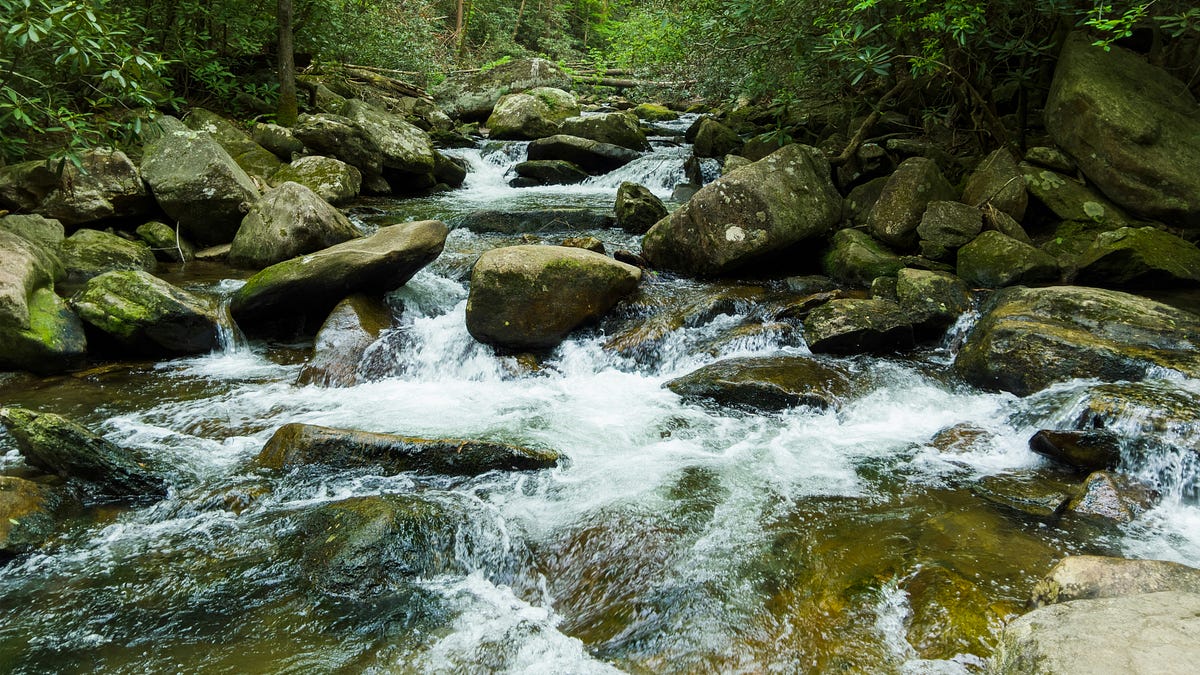
Although Shogoji sat in ruins for many centuries, in the late 20th century, Ikko Narasaki Roshi (1918–1996), with the help of Dainin Katagiri Roshi (1928-1990), initiated a restoration of the monastery. Their hope was that it would become an international Soto Zen training center.
We know practitioners who trained there in the late 80s and 90s who report the power of the place—and its still remote location, accessible only by walking up the mountain for about 45 minutes. Unfortunately, after the deaths of Katagiri Roshi and Narasaki Roshi, their dream for an international training center fizzled. As far as we know, Shogoji is again unoccupied.
You can learn more about the general decline in Japanese monasticism here:
 Dosho Port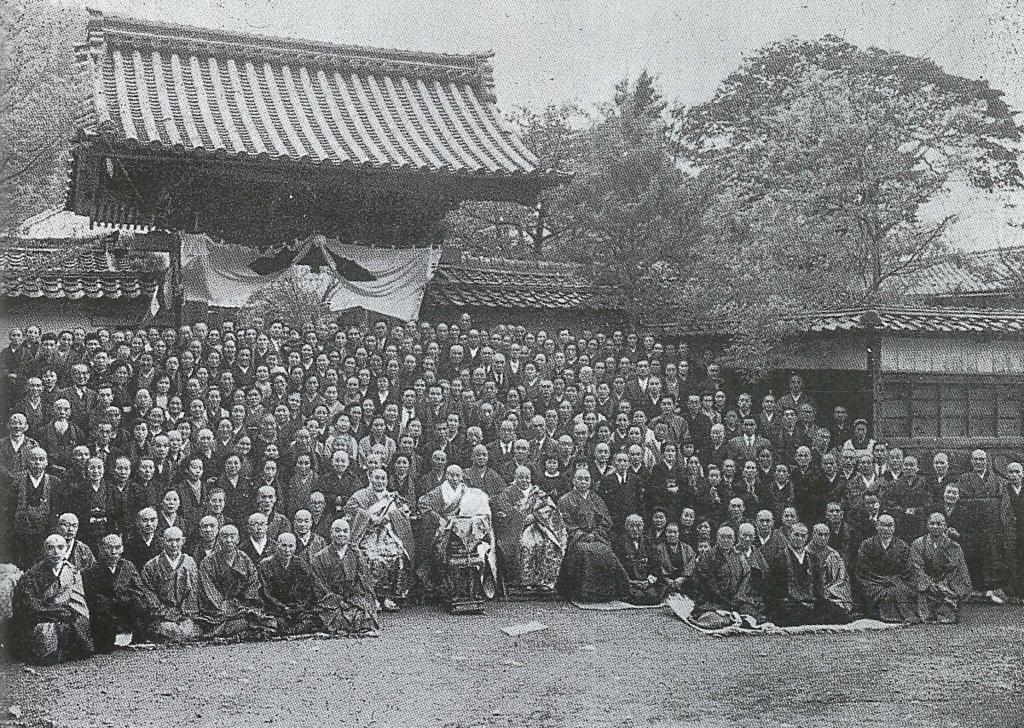
Now for the second part of the second part—"Daichi Zenji's Vows." First, we'll share his vows, then offer brief summary comments.
be dedicated to the boundless ocean of vows of the Three Treasures.
In all matters of daily life, may I never depart from the Buddha’s teaching. From this present life until I attain the body of a Buddha—
through birth and death, again and again—
may I never stray from the Dharma.
In each and every lifetime, may I tirelessly
guide all living beings toward liberation.
Though I may fall into the hells and face
the torment of sword-trees or knife-mountains,
or be plunged into boiling cauldrons and burning coals,
may I make the Treasury of the True Dharma Eye my sole reliance,
and be master wherever I am.
Humbly I pray:
May the Three Treasures bear witness.
May the Buddhas and Ancestors guard and guide me.
 IN THE MOUNTAIN RETREAT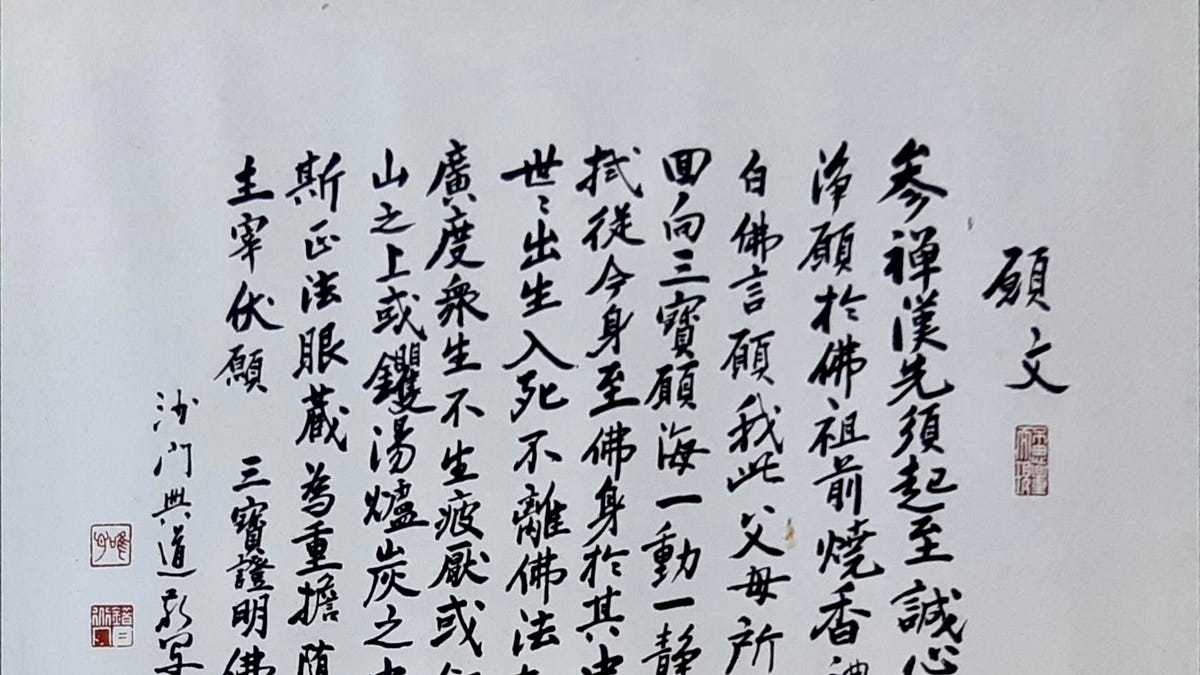
After recognizing the debt he owed to his parents, Daichi turned to the Three Treasures (Buddha, Dharma, and Sangha) and pledged to live a life fully in accord with the Buddhadharma (aka, renouncing worldly affairs). And even though he had experienced a great awakening, he recognized the long road to full and complete Buddhahood (i.e., he embraced the Mahayana's many stages of the Bodhisattva path). As a Bodhisattva practitioner, he vowed to "[...] tirelessly guide all living beings toward liberation," notably not to serve their transient sense desires and ego-clinging.
Even if he is reborn in horrifically painful hell realms, Daichi vows to rely on the Treasury of the True Dharma Eye. The "Treasury of the True Dharma Eye" here could refer either to Dogen's Shobogenzo or to that which Shakyamuni Buddha transmitted to Mahakasyapa—or both.
Through all of his dedication, departures, attainments, never straying, guiding, and sole reliance, he vows to be sovereign (i.e., "[...] master wherever I am"). These are not in conflict, but arise together.
We close by joining Daichi's humble prayer and invite you to join with us:
May the Three Treasures bear witness.
May the Buddhas and Ancestors guard and guide me.