Prioritizing Practice: Perspectives, Vignettes, and Consequences
"[...] When you prioritize practice, you will be tested in ways big and small."

If you want to go deeply into Zen—that is, to awaken to the great truth of this life—it is necessary to organize your life around your practice, rather than fitting your practice into intermittent seams in your life.
And if you feel a passion for this work, then this isn't something that you'll need to do by discipline alone—although there will be times when discipline is necessary. Instead, simply manifest the heart's innermost request and express your love for the buddhadharma by throwing yourself into practice.
However, we have found in our work with students that even when such an aspiration is present, the pressure from work and family—and especially from within students themselves—to do things other than practice often overrides their aspirations, both for daily practice and sesshin. Many people, Zen students included, passively follow along with other people's preferences for how they spend their lives. Some justify this passivity as "the Bodhisattva Way," a justification that we'll question in this post.
There are at least several reasons why students don't hold fast to their aspirations and their vows. First, a lack of awareness (or denial) of impermanence (i.e., the stubborn notion that "there'll be time later"). Second, a lack of information (or denial) about how far there is to go (i.e., Buddhahood). And third, a lack of perspectives and clear models that provide support for prioritizing Zen practice. This post is about the third point.
And in the spirit you'll often find here, we use the past as a model for the present:
 Dosho Port
Below we'll share a traditional dharma perspective in support of prioritizing practice and some vignettes from the lives of two Soto masters, Dongshan Liangjie (807-869) and Koun Ejo (1198-1280), and one contemporary Vine student, in order to offer models of real people who have indeed made practice a priority. We'll also grant that there are consequences (in addition to deep calm and awakening, along with the profound joy that arises through the process) for prioritizing practice by sharing an edited transcript of a snippet from the "Zen: One School, One Mind" workshop from Korinji.
More about this theme (i.e., the adverse effects of meditation) here, which strangely, has been one of our most popular posts:
 Dosho Port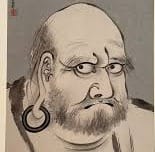
But what about my family?
Practitioners often feel torn between their family and their practice, and create additional obstacles by the way they handle or avoid the issue. Below you'll find a different perspective on benefiting your family. Three points:
- It has been long-established that one of the effects of samadhi is to melt away karmic seeds, and that awakening transforms the base (i.e., afflictive and cognitive hindrances).
- There is nothing greater that a person can give their family in this life than melting away their own karmic seeds and transforming the base.
- In addition, there is a long-held belief within several strands of the Buddhadharma that if a person awakens, seven generations of their ancestors experience relief from unfortunate rebirths. Seven generations of ancestors is 254 people!
So, if you are debating between doing a sesshin (where you might calm deeply and melt away some karmic seeds, or even awaken and transform the base of affliction) or attending a family function (e.g., a picnic where you'll reminisce about long-ago events and eat too much potato salad), the difference in impact is between 254 of your ancestors possibly experiencing freedom from hell, hungry ghost, or animal realm and someone saying to you, “Oh, it’s so nice that you are here," in addition to you gaining a few pounds.
Now, you might not believe that seven generations of your family will be relieved from unfortunate rebirths by your devotion to awakening and thereby skipping the picnic. But what if it were true? Are you really clear enough to know that your awakening will not benefit seven generations of your family? What if you had the possibility to free all of those people—the biological ancestors who made "you" possible–but instead went to a picnic? Are you so sure in your belief that you are willing to risk the consequences for 254 beings who may be suffering in the hell, animal, and/or hungry ghost realms?
From this perspective, is going to the picnic or going to sesshin more selfless?
However, just because you devote yourself to your practice for the sake of seven generations of your family doesn't mean the present generation of your family will smother you with appreciation. Your spouse, for example, may not be fully onboard with this "seven-generations thing" and so may still not be thrilled with your choice for how you use your vacation time. In other words, even if you succeed in saving seven generations of your family, others close to you may still have feelings about your priorities.
So it's likely that you will still have work to do with present relationships, perhaps re-negotiating your family responsibilities. We have found that some practitioners are not fully open, even with their significant others, about how important practice is for them and what training commitments they've made. It could be the case that the re-negotiating process would provide the opportunity for full disclosure and therefore greater intimacy, but that's only if one is willing to step into the discomfort of some friction.
In addition, with your lightened karmic load, the work will be easier. So you’ll have that going for you, too.
See below for the experience of Dosho and Meido Roshi's with this.

Vignettes in support of this perspective
From the many possible examples of practitioners who chose practice over complete adherence to family obligations, we'll highlight Dongshan, Koun Ejo, and a contemporary Vine practitioner.
Dongshan wouldn't see his mother
First, Dongshan took a vow when he became a homeleaver not to see his parents again. That was normative for monks in the Tang and Song Dynasties (618-1279). In those days, homeleavers literally left home.
See more about Dongshan here:
 Dosho Port
By the time Dongshan was in his early 50s, his father and elder brother had died and his other brother was "deficient," so his elderly mother found herself without a source of support. The Denkoroku (the source for this story, and the one that follows) says, "[...] Day after day, she searched for him, eventually taking up with beggars and making rounds with them, to and fro."
Then she happened to hear that her son was teaching at Dong Mountain (aka, Dongshan), so she went there to ask him for help. Dongshan chose to maintain his vow and refused to see her, "[...] locking his room in the abbot’s quarters and not letting her enter."
In anguish, his mother died outside his door. After her death, Dongshan found three cups of uncooked rice in her belongings. He donated these to the assembly as a part of the funeral prayers for her rebirth in a god realm. Shortly afterwards, Dongshan had a dream where his mother appeared and said,
“Because you firmly maintained your resolve and did not see me, I destroyed the basis of my deluded feelings of attachment and, on the strength of those good karmic roots, I have been reborn in the Heaven of the Thirty-three."
Koun Ejo defies the wisdom of the group
Ejo was very close to his mother and he consulted her frequently. She was influential in his choice to become a practitioner and to become a Zen monk. More about Ejo and his mother here:
 Dosho Port
So when her final illness came, she sent messenger after messenger to Koshoji, where Ejo was studying with Dogen (1200-1253), pleading with him to come for a final meeting. Leaving the monastery to visit his mother would require Ejo to break the rule about how many days a month he could be away. Although Ejo already knew what he would do, he asked the Koshoji assembly of 50 homeleavers, “My mother seeks a final face-to-face encounter with me. Should I break the rule and go to her, or not?”
They all agreed:
“Even though the prohibition is what it is, you are not likely to meet your loving mother again in this lifetime. You should earnestly request permission and go; do not spurn the will of the entire congregation. How could Dogen not permit it? This matter is already grave; it cannot be judged a minor matter.”
After the assembly had their say, Ejo replied,
“The standards of the Buddhas and Ancestors carry more weight than the findings of this congregation. Truly, they are the rules of propriety of the old Buddhas. If I were to follow along with the human emotions of my loving mother, it would go against the rules of propriety laid down by the old Buddhas. How could I, then, avoid an extremely unfilial transgression? Why do I say that? Because, if I were to violate the Buddhas’ procedures now, it would amount to a grave transgression on my mother’s part at the very end of her life. As a person who has gone forth from household life, I should lead my parents to enter the Way. If, on this one day, I follow along with human emotions, will I not cause her to be submerged in birth and death for everlasting kalpas?”
Keizan concludes this episode saying,
"So saying, in the end, Ejo did not abide by the deliberations of the congregation. As a result, the people in the congregation were struck dumb, and ultimately did not disagree with what Ejo had said. Everyone praised him, saying that he was truly a person of rare resolve."
 Tetsugan Osho
Staying in a 30-day retreat
But we don't have to look to long-ago and far-away. There are many examples of contemporary practitioners who defied the "wisdom of the group" and prioritized their practice. One such example is from our Vine community.
Several years ago, a long-time student entered a 30-day solo retreat. A few days in, they were contacted via their emergency channel and informed that their father, 500 miles from their retreat space, had been hospitalized and was in critical condition. Although we encouraged the student to continue the retreat, at the same time, we stressed that it was their decision to make—and live with. Despite some pressure from their family members, they decided to stay in the retreat. As it happened, their father's condition slowly improved. After the retreat, they then went to be with him and help out.
Sometimes the ship doesn't right
Meido Moore Roshi and Dosho spoke about this issue last August in the "Zen: One School, One Mind" retreat during the final Q&A session:
Question: "I’m interested in what you both have mentioned about prioritizing your practice within the context of your life, especially regarding whatever trade-offs that might be involved, and the kind of hard sacrifices one might have to make in order to realize that day-to-day. I wonder if both of you would be willing to share an instance when you made that kind of sacrifice and then felt like there was unexpected blowback. How did you manage to right the ship?"
 Dosho Port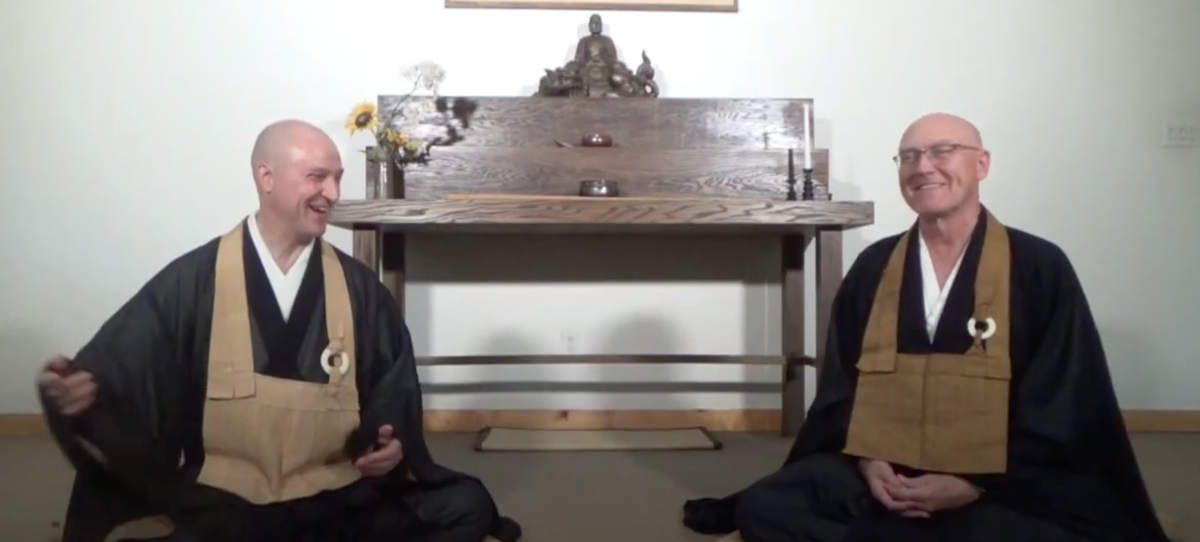
Dosho: "Sometimes the ship doesn't right. That’s part of the consequences that come from prioritizing practice. I often tell people I missed the whole '80s—don’t know the TV shows, movies, or music—because I was in zendo most of the time.
"At some point, though, like the late '90s, I started to prioritize my family more. My younger brother, who's now dead from multiple myeloma (and whom I didn’t spend as much time with as I would have, had it not been for Zen), noticed the shift and said, ‘You've moved from being a horseshit family member to being a piss-poor family member.’
"He always understood me."
"Also, one of my sisters, now dead from cancer, had been in a long-term relationship, living with her partner for over a decade. Finally, they decided to get married. Unfortunately, the wedding was planned for a time that I was committed to lead a sesshin. I think she was shocked, given our previous closeness and after this long build-up, when I said, 'I'm sorry, I can't come.'
"It turned out that she and her husband had everyone who attended the wedding sign a large poster-sized card. They then framed it and put it up in their living room. So every time I was at their house, there was a reminder hanging there that I had prioritized Zen. Our relationship never fully recovered.
"This is just something that is part of my life. I don't regret it. I have zero regret about focusing on Zen training. Yet, you should know that prioritizing your practice doesn't always turn out happily. If you make choices that prioritize training, it may hurt people around you. And that's something that you and they will have to deal with."
Meido Roshi: "For me, it was the '90s—movies, music, politics, and everything. I didn't even vote in elections until I got out of that training situation. I felt there was an aspect of my personal maturation and engagement with the world that was stunted. Also, I don't regret it."
"I have been married twice, and both of those relationships ended largely due to my commitment to something else–to my work, to the training. Work and practice were never different things for me. They were not the only reason those relationships ended, but significant contributors to that happening."
"I've worked 10 to 12 hour days, seven days a week since I was 22. But it was all my choice—I am not complaining. And this is not just Zen. I think anyone who has a passion for something like the arts or music or any other vocation may have that experience. I don't look at it in terms of a balance scale or tradeoffs, i.e., 'I lost this, I gained this.' It's just what I did, what I chose."
"I also left my family. All my family is on the East Coast. I'm the only one who left. I see them once a year, twice a year sometimes. Those relationships are not lost. They're not broken, but I haven't been able to enjoy them the way they have enjoyed each other. I'm the one who left."
"There are many things like that, but again, I don't think that's special. I think anyone who commits to anything has that experience. Is it worth it? Yeah. Do I regret it? No. Is there a certain wistfulness, yearning, sadness, mourning for some of those things? Yeah. But I made the choice."
"I'm more concerned about how I use the rest of my life from this moment forward. I want to make each day make what has been sacrificed worthwhile and to justify all the support that I got along the way. We say 'to requite our debt of gratitude.' Every bowl of rice we eat here was donated by someone. How do I deserve that? Am I using it fully?"
Last word
In talking with the Vine student mentioned above about this post, they noted,
"It's worth saying that when you prioritize practice, you will be tested in ways big and small. It's never as easy as just making the decision once. I had always heard that, and then was still surprised when I was tested in that 30-day retreat."
Keep that in mind.
Comments welcome (open for paid subscribers)

Up next
"Your Parents’ Rotting Red Flesh: The Meeting of Pivotal Zen Ancestors Rujing and Xutang"
In case you missed it
 Shake Out Your Sleeves And Go