Why Study "Mere Perception?" And Why Study Dharma At All
"When we abandon external objects, delusion is extinguished and nirvana is verified."

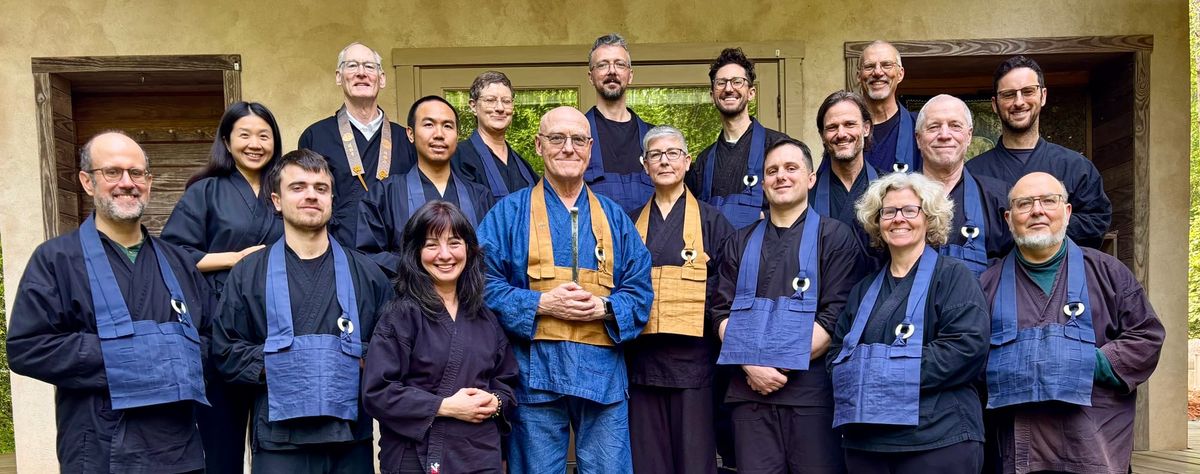
Recently, the students in training with the Vine of Obstacles Zen have begun working with the teaching of mere perception. If you are interested in Zen training, you can learn more about our program here:
 Dosho Port
Paid subscribers are invited to attend our Sunday talks, now on the theme of mere perception. If you are so inclined:
We raise this teaching on mere perception not as a philosophical inquiry or to propose a dharma doctrine, but as a teaching that arises from the Bodhisattva Vow. If we are to liberate ourselves and others, we need to know what’s going on here; otherwise we’re likely to stumble around ineffectively, misdirecting our energy and wasting time rather than becoming a Buddha.
If you are interested in becoming a Buddha, you can learn more here:
 Dosho Port

And the amazing proposition in the buddhadharma is that if we really know what's going one (aka, "intimate self knowledge"), we awaken.
In that regard, the Buddha and the Yogacara masters tell us that what we perceive is mere perception. In the great Korean master Woncheuk’s (613-696) extensive commentary on The Sutra that Explains the Profound Meaning, he raises the question of why:
“Why does Buddha teach mere perception?”
Some Viners have been wondering about this too, so in this post we will share our in-house translation of Woncheuk’s answer to the "why?" question with our inserted comments.
Woncheuk begins:
Woncheuk begins here, as he often does, by grounding his response in the sutra and commentarial tradition. The All Inclusive Commentary clarifies the point of the study—to realize the Middle Way, i.e., to awaken and become Buddha.
Study is also important for Zen students. Zen Master Fayan (885-958), the founder of one of the five houses of Zen in China, wrote:
So, study [of the Buddhadharma] is essential for kensho—for you and for future generations.
Note that for the Buddha and Yogacara masters, mere perception does not refer to seeing external objects as dependently arising (i.e., empty of inherent nature), but to abandon the misconception that there are external objects.
Vasubandhu (ca. 320–400 CE) succinctly expresses this view in his Thirty Verses (17):
All these consciousnesses transform,
Discrimination and that which discriminates,
All are not other,
For this reason, everything is mere perception.
You might sit quietly and reflect on that.
Woncheuk continues:
Next, Woncheuk lays out the negative consequences of grasping at an external world with graspers and that which is grasped—we suffer with the two types of discriminations. Instead, he exhorts us to realize peace, “the equality of true emptiness,” by intimately seeing what’s happening within the process of perceptions.
As Tenshin Anderson Roshi (1943- ) says in his commentary,
“It’s a constructing mind that arises, and the proof that it’s a constructing mind is that it has constructions. Mind does not construct something other than itself. We live [as] the intimacy of our constructing mind. This sutra is the revelation of this deep intimacy.”
Woncheuk continues:
Ouch! Ouch! What is the root of our external world delusions? Voracious desires and clinging to pleasure. While we’re so enmeshed in the show, there is no hope. All provisional strategies are just rearranging the deck chairs on the Titanic.
Woncheuk continues:
Even though there seemed to be no hope, no causes for liberation, suddenly, the Tathagata appears in the storyline and “skillfully and compassionately" teaches mere perception. Phew!
And Woncheuk reiterates his central message:
When we abandon external objects, delusion is extinguished and nirvana is verified.
Woncheuk concludes:
Finally, Woncheuk offers important framing for the teaching of mere perception. Neither the great Yogacara masters nor all the Buddhas are advancing a philosophical doctrine. They are dispensing medicine to the assembly of practitioners who take refuge in the Triple Treasure.
To receive the medicine, one must be part of an assembly and do a whole lot more than skimming a message like this one. That’s like glancing at the label of a prescription—it won’t be of any power to heal what ails you.
Instead, the Buddha taught the three wisdoms. First, carefully read the label and all accompanying material with directions for proper use. That is, fully understand how this medicine works.
Second, open your mouth and ingest the medicine! That is akin to reflecting on the teaching, really absorbing the implications. Many contemporary practitioners go wrong by just reading the teachings without taking time to reflect on them, wrestle with them, appreciate them from various perspectives, and play with putting the teaching into their shoes, just having some fun with it all.
Finally, digest the medicine so that it becomes your skin, flesh, bones, and marrow. That is, put the medicine to use—manifest the medicine in sitting, standing, walking, and lying down. In this case, actually abandon external objects and rest in mere perception. Afflictions will cease and you will realize awakening. Why not give it a whirl?