Are You Ready for Urgent Practice? Twenty-five Considerations
"One-pointed creative application precisely distinguishes the Way."
Great Master Zhiyi (538–597 CE) identified twenty-five "outer" means or preparations that make doing intensive, urgent practice possible. These outer means are seldom addressed in the contemporary dharma scene, so you're in for a dharma treat. "Outer" is in contrast to "inner," that is, the inner methods of meditation and practice in general, like breath work, koan, liturgy, etc. The categories, or course, are not mutually exclusive.
Although Zhiyi seemed to be thinking of the twenty-five for students entering long solo retreats, all twenty-five can be considered in light of your householder practice. They point to areas that you might already have developed, and other areas that might need some work.
I hope the following introduction to the twenty-five clarifies and inspires what it really means to practice such that one can realize the same mind as Buddha. The heart of the matter is renunciation, our central theme for the Vine of Obstacles this year. About renunciation, a Vine student recently wrote,
 Dosho Port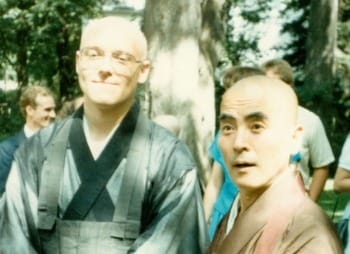
Renunciation can be scary, for sure. But also liberating. So let's dive right into Zhiyi's twenty-five means. They are nicely organized into five sets of five: conditions, renunciations, hindrances, things to regulate, and skillful practices.
You can find more – indeed, much more – in The Great Stopping and Seeing, translated by Paul L. Swanson as Clear Serenity, Quiet Insight, 574-710. In this teaching, Zhiyi devotes about 135 pages to the twenty-five means. Below, I'll give you an overview in about 2,500 words.
 Translation and commentary by Paul L. SwansonSeries: Nanzan Library of Asian Religion and Culture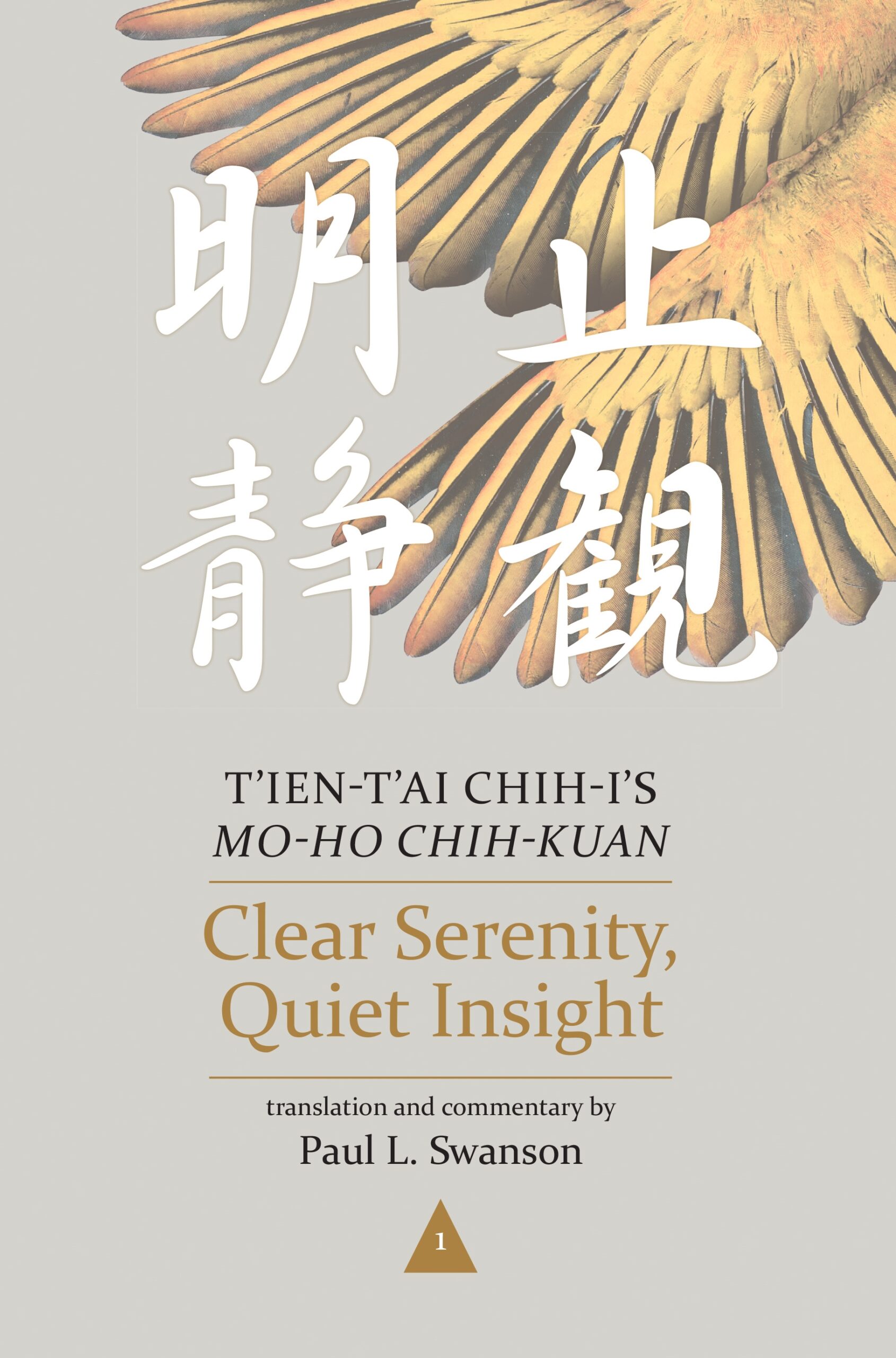
The five conditions
"Keep the precepts," might seem obvious, but Zhiyi works the theme in a thorough and profound manner that wonderfully complements the precept work we do "in the room" in the Harada-Yasutani koan curriculum. Although his expansive commentary is beyond the scope of this post (see 580-637), I will be returning to this topic in the future.
Suffice it to say that keeping the precepts is the basis of any intensive training. When one doesn't keep the precepts, it simply creates a rocky road, a road on which it is very difficult to find peace and harmony. And then there's how not keeping the precepts affects others. On the other hand, if a practitioner views them from the conventional/moral perspective alone, the precepts become donkey-tethering stakes.
The next few conditions – make arrangements for adequate food and clothing, dwelling in a quiet place, and taking a radical break – are something that householders can aim for. It is important that practicing deeply depends on taking care so that sufficient food and clothing are available. Likewise, taking good care of your life sets the ground for deep training, and one of the ways of taking good care is by discerning what responsibilities are most essential (more on that below).
Zhiyi notes, first quoting The Sutra on the Life of the Buddha, that
"The Tathagata attained unsurpassed, complete awakening after eating." Although this was only one small condition, it led to a great event. If you are naked and hungry, how can you calmly practice the path of the Dharma?
Zhiyi also points out how our practice is our clothing. Stopping and seeing protects us from the mosquitoes and flies of opinions and views. Ultimately, it is the practice itself that adorns the body of the realized Buddha.
Now, what about "put an end to all mundane responsibilities"? Aren't mundane responsibilities the very essence of a householder's life? Yes, and householders can find periods of time, like in sesshin, where such a radical break is possible. For example, one Vine student who leads a very full professional life recently completed their first sesshin and said it was the best week of their life, largely due to completely dropping all their responsibilities.
So, the critical message for householders is – simplify your life! Each day, set aside some time to put end to all mundane responsibilities, as we do in zazen:
Also, you might experiment with taking some time before sleep for not getting anything done and recalling your deepest intention for this life. Stay off all internet-connected devices and let go of all entertainment. Just reflect the vow for awakening quietly without doing anything at all.
You might also consider how, within your present circumstances, you could move in the direction of simplicity in diet, clothing, dwelling, and involvements. Aim for a minimal use of time and energy on these things so that you have more time and energy for the Way. And yet, Zhiyi also points out:
If you know well the arising and perishing of the phenomenal features of this world, what is there about the various activities that you will not know? You know through universal wisdom and perceive with the Buddha eye. If you wish to practice the great path, you should not learn with a limited scope.
So, although it might be ideal to find a place deep in the mountains and faraway valleys, or on the shore of a great lake, the place of true practice is the place where you can integrate the conventional and empty perspectives – like right where you are, wherever you are.
In the same vein, in our Zen lineage, one fruit of practice is to become a person with nothing to do. For example,
To be unusual in this regard might reflect that this one person is a highly accomplished practitioner – with nothing to do.
Finally, we don't do this work alone, so the fifth of the first set of five is to find good friends (kalyanamitra). There are three types of good friends, and for urgent practice we need all three. The first type supports the practitioner physically, providing physical or psychological space for practice and some of the above forms of support, too. Many Viners have spouses who play that role. The second type are peers, especially senior practitioners, who inspire and support practice. Many Viners are good friends for each other in this way. Those who distract you from what's most important are not such good friends. And the third type of good friend is a teacher. I've written about this last type fairly recently, so will just point this out for you:
 Dosho Port
Renouncing the five desires
Renouncing sense desires is the most radical activity a practitioner can engage in today. Our economic system has commoditized sense desires, with the promise for the satiation of that which is insatiable. And if you're not satiated yet, get more, be more, do more. That a meaningful life can be found chasing after sense pleasures is a false promise that leads many to waste this precious human life.
If you feel resistance to the notion of renouncing sense desires (i.e., you are a normal human being), I recommend that you sit quietly and reflect on who is resisting what. And inquire – what are the consequences of a life attached to transient sense pleasures?
Zhiyi offers an extensive discussion of renouncing sense desires from the conventional, empty, and Middle Way perspectives. He acknowledges that one trap is to live a life focused on indulging sense pleasures, and another trap is living a life being opposed to sense pleasures:
Do not be attached to either extreme; this is neither to grasp sense pleasure nor to be detached from sense desires. This is to manifest visible form and the true aspect of the Middle Way.
A Zen short-cut method to renouncing sense desires is found in The Diamond Sutra, Chapter 26, and is included in our Miscellaneous Koans:
How will you meet the Tathagata (i.e., that which thus comes)? An explanation, of course, won't be the visible form of renunciation.
Reject the five hindrances
Working with the five hindrances is one of those powerful teachings that runs through the entire tradition of the buddhadharma – Zen, Tibetan, Vipassana, Tendai, etc. The essential practice is to notice when you are grasping (i.e., greedy) or pushing away (i.e., angry), and simply illuminate the bodily sensations associated with these two hindrances with bare attention (no judgement). The same applies to slumping (lethargy) and excitement (restlessness and remorse) – simply illuminate the bodily sensations associated with these two hindrances.
The antidote to doubt, though, is different. Indeed, three kinds of doubt are identified with their own antidotes: doubt in oneself, in one's teacher(s), and/or in the buddhadharma. For doubt in oneself, the antidote is simple. Reflect on this precious human life and determine not to waste time wallowing. Zhiyi:
Reflect as follows: "It is difficult to obtain a human body, and difficult to arouse a mind that is in awe. I should not be deluded by doubt and thus deluded by doubt and thus damage and destroy myself."
As for doubt in your teacher(s), Zhiyi encourages us, following The Commentary on the Wisdom Beyond Wisdom Sutra, not to throw away gold just because it's wrapped in smelly bag. I can attest to the smelly bag part.
And instead of lingering in doubts about the buddhadharma, cultivate faith in the buddhadharma by studying the buddhadharma. That is, see for yourself. Zhiyi:
If in your mind you have faith in the Dharma, the Dharma will permeate your mind. If you wallow alone in your doubt, this is the same as a vessel that is overturned [and can receive no sustenance].
For example, see Zhiyi's The Small Stopping and Seeing, published as The Essentials of Buddhist Meditation: The Essentials for Practicing Calming-and-Insight & Dhyana Meditation, translated by Bhikshu Dharmamitra (a PDF is free from the publisher – they just ask for a small donation) with a detailed teaching on working through the five hindrances. The full title is The Brief Clarification of the Essentials of Stopping and Seeing Zazen for Beginners to Open their Blind Eyes (also in Clear Serenity, Quiet Insight, 1659-1759).
A Zen shortcut method to penetrate the five hindrances is to pass through this one koan from the Third Ancestor:
And actualize it in daily life.
Regulating five things
As for diet, it is recommended to neither starve, nor reach satiation. Eating until half or two-thirds full is what's often recommended. From our meal sutras:
This morning meal of ten benefits,* nourishes us in our practice. Its rewards are boundless, filling us with ease and joy.
(*Ten benefits: healthy color, strength, longevity, comfort, good speech, digestion, preventing sickness, relieving hunger, relieving thirst, and suitable excretions.)
Likewise with sleep. Moderation is recommended. Zhiyi:
Sleep is food for the eyes; it cannot be forcibly restrained. [If you try to do so,] mental activity increases and your efforts are wasted. But neither should you sleep unbridled.
The third, fourth and fifth things to regulate – body, breath, and mind – are still the foundation of zazen in the Zen school (on and off the cushion). Zhiyi advises us to regulate the body so that it is neither hyperactive nor sedate; the breath is neither uneven nor too smooth; and for the mind, to arouse bodhicitta, it is neither too difficult nor to easy. Zhiyi:
If you are able to regulate the body, breath, and mind of an ordinary person, you will be converted into the body, breath, and mind of a Noble One. Regulating the body is the cause for keeping the precepts, regulating the breath is the gate for entering samadhi, and regulating the mind is the cause for the birth of compassionate wisdom.
Undertaking five skillful practices
With regard to aspiration, the practitioner leaves the pursuit of sense pleasures and enters absorption – joyfully and without becoming weary.
With regard to diligence, the Buddha taught
With regard to mindfulness, continuously remember the buddhadharma. Specifically, "[...] to singularly seek only the quiescence of nirvana and not to be mindful of other things."
With regard to skillful discernment, "[...] discriminate between the faulty afflictions of samsara - which should be renounced by the wise and noble - and the calm bliss of nirvana, which the Noble Ones praise."
Finally, single-mindedness is the essential ingredient. Dogen, for example, wrote, "One-pointed creative application (專一功夫; Japanese, sen'itsu kufū) precisely distinguishes the Way."
And Zhiyi concludes our discussion of the twenty-five means with this:
With single-mindedness we put an end to the two extremes of the conventional and the empty so that the mind is like pure, clear water, so that we can know the marks of the arising and perishing of phenomena; such a mind is nondual, pure, and always integrated, and sees with prajna-wisdom.
Thanks to Tetsugan Sensei for her many contributions to this post and to you for reading.
The comment section is open for paid subscribers. Questions and comments are welcome.
For more on Zhiyi's perspective on the path, see:
 Dosho Port