Dogen's Private Notes from the Hokyo Era: Obstructions or Picking and Choosing?
"Taking a shower won’t fix your heart problems."

The luminous mind is hidden by the three poisons, the five desires, and the five hindrances (for starters). Without dealing directly with these obstructions, a practitioner will swirl around and not discover one-pointed equanimity or deep awakening. Therefore, the obstructions are addressed in many dharma texts in both the Individual and Great Vehicles, including in The Pali Canon, The Path of Purification, The Great Perfection of Wisdom Sutra (and commentary), The Yogacarabhumi (and commentary), and in the works of Zhiyi, such as The Great Stopping and Seeing.
So it is not surprising to also find that the obstructions to awakening are repeatedly addressed by Rujing in Dogen's private notes from his time in China in what is now known as Hokyo-ki. Indeed, the character for hindrance, 葢, is used 24 times in this short text. And given that Rujing's famous admonition to just sit, 打坐, occurs only 3 times and the phrase shikantaza, 祇管打坐, occurs just once in Hokyo-ki, it could be argued that the text is more about working with hindrances than just sitting.
In this post, we’ll explore two key passages from Hokyo-ki and how householders can apply these teachings. We believe that the two questions Dogen raises about obstructions in these two selections point to beliefs still held by many Zennists today.
What are those beliefs? First, that working with the obstructions to awakening is not the approach of the Zen lineage, because it betrays a mind of picking and choosing. And second, working directly with the obstructions is not a method approved of in the Great Vehicle tradition of which Rujing was a representative, because to address the obstructions directly are practices associated with the Individual Vehicle.
Curiously, these beliefs persist despite the fact that of the six seminal source texts listed above (a small selection of the vast literature of the buddhadharma that deal with karmic obstructions), only the first two are from the Individual Vehicle tradition. Indeed, as we wrote in an earlier post on this topic, in The Great Stopping and Seeing, the great Mahayana Master Zhiyi has 134 pages just on working with the five desires. We wrote at that time:
You can find more about Zhiyi's teachings for working through the obstructions, including the five desires in this post:
 Dosho Port
Furthermore, freedom from the hindrances is included in the verse for taking refuge in the Sangha:
May all beings
Support harmony in the community
Free from hindrance
Only when everyone in community addresses their desire, anger, lethargy, agitation, and skeptical doubt is harmony in a dharma community possible. Dogma about not picking and choosing simply doesn't reach it.
Why is it that now and in ancient times, practitioners looked for a way around the obstructions? First, due to our attachments to them, of course. And second, being free of the obstructions is no easy thing. Nagarjuna, in The Great Perfection of Wisdom Treatise, notes, "Meditative concentration [i.e, being free from obstructions] is difficult to achieve. [However, if] a Dharma practitioner seeks it single-mindedly without giving up, then they will attain it."
Now for two original annotated translations of passages from the Hokyo-ki. Brief comments follow each.
Is working with the obstructions just picking and choosing?
Dogen bowed and asked, “In recent times, doubters say, ‘The three poisons are the buddhadharma, the five desires are the Ancestral Way.[1] If you remove those, it’s just picking and choosing, the same as those of the Individual Vehicle.’”[2]
The venerable abbot [Rujing] presented, saying, “Those who don’t remove the three poisons and five desires are just like Kings Bimbisara and Ajatasatru and those outside the Way.[3] If a descendent of the Buddhas and Ancestors removes just one hindrance or one desire, that would bring great benefit.[4] This would be a moment of seeing together with Buddhas and Ancestors.[5]
the three poisons are greed, anger, and ignorance. the five desires in this context are grasping at sense objects through each of the five sense gates - seeing forms, hearing sounds, smelling smells, tasting tastes, and touching things. ↩︎
Individual Vehicle, 小乘, aka, Hinayana, more often translated as "Small Vehicle." From the Great Vehicle, Mahayana perspective, the Hinayana refers to practitioners bent on their own individual liberation and so haven't aroused great compassion. "Individual" seems more descriptive and less disparaging than "Small." ↩︎
Kings Bimbisara and Ajatasatru, kings of Maghada at the time of Shakyamuni Buddha who were engaged in multiple complex dramas, including Bimbisara trying to kill his son, Ajatasatru, and Ajatasatru, at the urging of Devadata, eventually succeeded in killing Bimbisara. Ajatasatru was later killed by his son. Rujing uses them as examples of what happens when we are swept away with the five desires—i.e., things don't end well. ↩︎
Rujing may be referring to a passage by Nagarjuna in The Great Perfection of Wisdom Treatise. Nagarjuna first quotes the Buddha of the Pali Canon saying, "'If you put an end to one thing, I will confirm that you have attained [the fruit of a] non-returner. And what I mean by that "one thing" is greed.'" Nagarjuna then comments, "Why did he speak of only putting an end to the one thing? It is because people have a marked inclination for greed, and all the other fetters are generated from it. This is why, when greed is eliminated, the other fetters are ended as well." ↩︎
seeing together in Japanese is shoken, 相見, Digital Dictionary of Buddhism: “A formal meeting between a disciple and a Zen master for the purpose of seeking and giving instruction.” In some lineages in contemporary Zen, shoken refers to a close teacher-student relationship, formally entered with the student bowing and offering the teacher(s) a small gift. ↩︎
Highlights
The most striking thing about Dogen's question is that he felt the need to ask it. The interactions he had with other Chan masters in China and perhaps the approach of the Daruma-shu in Japan are likely culprits for "doubters."
The first of the three poisons, desire, and the first of the five hindrances, desire, are disaggregated by the five sense desires that Dogen cites above. And although the above source texts differ in some regards, they all sing the same tune about the obstructions in general and the five desires specifically. Nagarjuna (150 CE - 250 CE), in The Great Perfection of Wisdom Treatise, for example, says:
Rujing then compares those who have done away with working through the obstructions to those who have not abandoned worldly affairs, like Bimbisara and Ajatasatru.
Rujing's final two sentences are most striking. First, that removing just one poison or one of the sense desires will bring great benefit—no small (or individual) thing at all. So much so that in so doing, we see together with Buddhas and Ancestors. Or, perhaps Rujing is making it personal. The characters are neither plural nor singular, so he could be saying to Dogen that when Dogen removes even one obstruction, this is a moment of seeing together—seeing with the same eyes, hearing with the same ears—with him, a Buddha Ancestor.
In the next passage, Dogen also makes it personal with the question he raises about Rujing's practice.
Are you both a Great and Individual Vehicle practitioner?
Dogen bowed and asked, “Is freedom from the five desires and removing the five hindrances the same as what is spoken of in the teaching schools?[1] That is, [are you] someone who is a practitioner in both the Great and Individual vehicles?”
The venerable abbot [Rujing] presented, saying, “Descendents of the Founding Ancestor [i.e., Bodhidharma] are not suspicious of the teachings of either the Great or Individual Vehicles. A person in training who turns their back on any of the Tathagata’s holy teachings would not dare to become a descendent of the Buddhas and Ancestors.”[2]
The five desires are noted above. the five hindrances are desire, anger, lethargy, agitation, and skeptical doubt. teaching schools, 教家, Digital Dictionary of Buddhism:"Those who advocate scriptural study as the primary approach in their systems, as distinguished from those who emphasize a meditative approach." ↩︎
Would not dare because turning one's back on the Tathagata's teaching would be opposite of kanno doko, "the interacting communion of appeal and response." ↩︎
Highlights
First, the young Dogen had some hutzpah, asking the aging abbot of one of the foremost Mahayana monasteries in the world, Tiantong, if he was also a Hinayana practitioner. And the old master responds with aplomb. Anyone who is a descendant of the Buddhas and Ancestors would respect, or at least would not be suspicious of, all the holy teachings of the Tathagata.
This comment clarifies the meaning of the line from Bodhidharma's famous verse, "Not dependent on words or texts." The Zen lineage is not dependent on any word or set of words. Therefore, any of the Tathagata's holy teaching can be uplifted–according to time, place, and circumstances—and employed to liberate living beings.
We will return to this important theme in a future post that will highlight another passage from Hokyo-ki where Rujing unpacks this view.
How to work with the obstructions
Now that we've emphasized the importance of working with the obstructions, how is that to be done? What skillful methods can be employed? We presented Rujing's approach to diligent practice with the hindrances here:
 Dosho Port
We summarized this teaching like this:
For now, a few additional methods for working with the obstructions that are shared widely across the Buddhist tradition.
First and foremost is the recognition that the obstructions are obstructions. As such, they are barriers to our intention to settle deeply and awaken thoroughly—for the benefit of all beings. In this spirit, Zhiyi says:
Note that this is not a moralistic stance (i.e., that the obstructions are evil), but a pragmatic one. In order to live congruently with our vows, the heart's innermost request, the obstructions must be removed.
Nagarjuna, again in The Great Perfection of Wisdom Treatise, elaborates on the point of being free from sense desires through knowing their conventional nature:
Second, in order to be free from obstructions, apply the Zen spirit of cultivating few desires by practicing simplicity in food, clothing, and housing. Much more about that here:
 Dosho Port
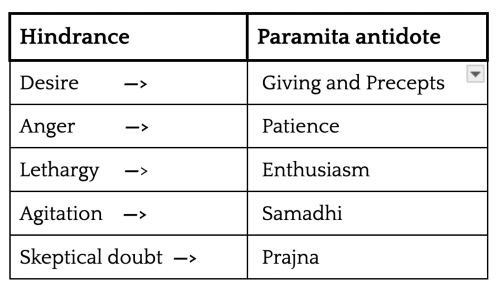
Third, work through the five hindrances by perfecting the six perfections (i.e, paramitas). Note in the table below, the paramita that is the primary corresponding antidote to which hindrance is identified. Significantly, both the giving and precept paramitas are antidotes to the first hindrance, desire. This is, after all, the desire realm, so it takes two paramitas to take down the desire hindrance!
Wrap up
Working with the obstructions is necessary for deep calming and seeing nature—i.e., awakening. There is no way around it whether you are working with the breath or a koan.
Many great masters of the buddhadharma, including Nagarjuna, Zhiyi, and Rujing, offered methods for specifically addressing the obstructions. The word "specifically" here is important.
Recently, in working with our Vine of Obstacles Zen students, we found that many were feeling stuck in a hindrance. And when we examined how they were working with the hindrance, we found they were not applying the correct paramita antidote.
As one Viner succinctly put it, "Taking a shower won’t fix your heart problems."
In case you missed it
 Shake Out Your Sleeves And Go
Coming soon—one more post on the karmic hindrances
"Dogen's Private Notes from the Hokyo Era: You Must Not Deny Karma"